
6 April 2005: Study: Cognitive Therapy As Effective As Drug In Treating Depression…In a study of 240 patients, researchers found that Cognitive therapy, a type of treatment that teaches patients to think more realistically, worked as well as a popular antidepressant for moderate to severe depression…If people quit taking Paxil (Paroxitine) after four months, their relapse rate was twice that of therapy patients…it establishes I think once and for all that cognitive therapy does as well as pharmacotherapy, and what’s even more important is that it has a much lower relapse rate,” said Beck. University of Pennsylvania.
In the mid 1950’s, the two therapies of Freudian Psychoanalysis and Behaviourism were fatally wounded by unscientific attitudes, procedural ineffectiveness and a failure to differentiate between a laboratory rat and a human being.
In 1955, Dr Albert Ellis, a New York Clinical Psychologist developed Rational Emotive Behaviour Therapy (REBT) and from this, in 1967, Cognitive Behaviour Therapy (CBT) evolved through the work of Dr Aaron T. Beck, Professor of Psychiatry at the University of Pennsylvania school of Medicine and Director of The Center for Cognitive Therapy in Philadelphia.
Ellis was recently voted the second most influential Psychotherapist of last century by the American Psychological Association Members, first by the Canadian Psychological Association. REBT is based on the premise that people are not so much disturbed by events, but by our perception of them. “Tell me one thing about the past. I’ll prove it’s not what upset you. It’s how you philosophized about it that made you disturbed” Dr Ellis 19th August 2005.
“Most forms of human psychological disturbance are a form of demandingness with inaccurate definitions “. Dr Albert Ellis.
Cognitive therapy actively encourages self-monitoring and behavioural assignments to assist rational, effective thinking. The client is very much the person who gets self better with the help of the therapist. The world is the laboratory, the client the scientist and the therapist the guide. You can feed a person for the day or teach him how to hunt for the rest their life. You take the cure with you wherever you go. You are back in control. “Given CBT’s, focus on modifying thinking and transferring skills learned in therapy to everyday life (i.e. making the patient his or her own therapist) treatment effects would be expected to persist following termination”. Beck 1995
Clients often request hypnotherapy rather than psychotherapy. Hypnotherapy for far too long has been mis-interpreted as some magical, mystical cure both by clients and therapists alike. After twelve years using it, I have found its effects to be excellent allied with REBT. Hypnotherapy is useful for allowing the client to visualise themselves in the problematic situation and then applying rational self-helping thinking.
“Most anxious patients have visual images of danger before and during their anxiety”. Beck, Anxiety Disorders and Phobias
‘The public remains largely unaware of the research supporting the efficacy of CT or other talking cures. But numerous studies show cognitive therapy is as effective as medication at treating depression, and often better than drugs for conditions like anxiety and obsessive-compulsive disorder.’ Washington Post September 3 2002
I now present to you rational emotive cognitive hypnotherapy which will help you manage life’s difficulties and self-created emotional disturbances so that you will be able to go into any situation and significantly move anxiety, anger and depression into concern, annoyance and sadness and allow yourself to move towards happiness. I present real case histories a recognised model for understanding nervous illness and a factual account of my fast recovery from a stroke using RECH.
An historical perspective
In the first and second centuries A.D. the slave Epictetus is quoted as saying “men are disturbed not by events, but by the views we take of them.” In the eighteenth century the philosopher Emmanuel Kant said that we are never able to perceive reality directly but only to see things filtered through mental categories. In the nineteenth century Alfred Adler, like Sigmund Freud, believed that a child’s formative years were extremely important in moulding the personality. Freud pursued the theory of unconscious libidinal drives while Adler asked the question: “What does the world seem like to a small child?”
He felt that human beings began life with natural inferiority as adults and the world in which (s)he lived were bigger than the child, and as a consequence of this perception the child would compensate. Adler asked parents to encourage the child to build confidence and self-esteem. Adler was a social psychologist who believed in social interest and that a person’s mental life is determined by his goal: Teleology. If the child’s attempts for recognition were met with persistent criticism or lack of love (warmth, comfort, safety and excitement) the perception of being inadequate would make the child behave in a manner which was incongruent and therefore detrimental to the psyche.
Adler termed this: Private logic, the person’s inner belief system is based on biased apperception rather than common sense, it is unique to the individual and it is the glue which bonds inferiority and behaviour to fantasy goals. Security without security! Realistically destructive.
“The meaning that is attached to events determines behaviour.” and thus Adlerian therapy involves re-educating the client towards a more satisfactory lifestyle, by changing his attitudes, his goals, his values and his behaviour.
Murray and Jacobson rightly described Adler as the forerunner of many modern cognitive therapists such as Albert Ellis, Julian Rotter, George Kelly, Eric Berne and Aaron Beck.
George Kelly.
In the 1950’s when behaviourism was the dominant psychology George Kelly recalls how he sat through many lectures watching Stimulus to Response being written on the blackboard and waited for the teacher to explain the meaning of the arrow. Influenced by Emmanuel Kant, Kelly regarded man as a scientist who constructed his own interpretation of the world.
Aaron Beck
Originally a psychoanalyst Beck became increasingly frustrated with its lack of efficacy. His observations in the early 1960’s with depressed patients showed a negative bias in their thought processes, rather than the Freudian concept of anger being turned inwards – reversal. Beck labelled this a cognitive triad where the client has a negative view of self, the world and the future. Beck believed that the way a client structured incoming information – schemata – led to the client’s emotional disorders. Beck’s therapeutic approach was to track down and have the client test the validity of these negative automatic thoughts, and then to replace them with more effective ones. As Beck’s cognitive therapy has progressed, trials on its effectiveness have shown increasingly encouraging results
“The conclusion from these treatment trials is that cognitive therapy is at least as effective as anti-depressant medication in the treatment of unipolar non-psychotic major depression.” Aaron Beck.
Albert Ellis
Like Beck, Ellis was originally a psychoanalyst but found it “inefficient.” He differed from Beck inasmuch Ellis would zero in on the irrational beliefs and the emotions it brought to the client. Ellis also believed that humans have a strong tendency to think and act irrationally. He originally named his method Rational Therapy; however he later changed it to Rational Emotive Therapy as he felt there were misconceptions that rational therapy was only concerned with thought. Ellis held that thought, emotion and behaviour were all closely linked. In 1994 he changed the name of his therapy again to Rational Emotive Behavioural Therapy.
REBT is a problem solving approach to emotional disorders. It has been described as psycho-educational, the client is encouraged to scrutinise and review his irrational beliefs such as the social phobics one of “I must come across well in front of significant others, and if not it’s awful, I’m a damnable person, I can’t stand it” (ego disturbance) and be taught that the self defeating “musterbatory” belief could be replaced with a preference thus moving anxiety to one of concern.
At the1995 Evolution of Psychotherapy conference, even the behaviourist Dr Joseph Wolpe acknowledged that cognition was important when he remarked to Dr Albert Ellis’ surprise
“There is an important point that Al Ellis made about cognitive events in therapy. Yes, cognition enters into everything that we do…..” (Wolpe 1997, p. 199). Dr Ellis continues in his book Overcoming, Destructive Beliefs, Feelings, and Behaviors p.235 “The point I am making is that just about all therapy with humans, including pure behavioural analysis, inevitably has important cognitive elements and would hardly exist without these elements. But I want to particularly emphasize that when clients easily and naturally use their language systems to make self-defeating conclusions about themselves, about others and especially about the” horror” of their panicking and depressing, probably the best and most thoroughgoing way to help them is to teach them philosophic methods of change, especially how to think more accurately about their thinking”.

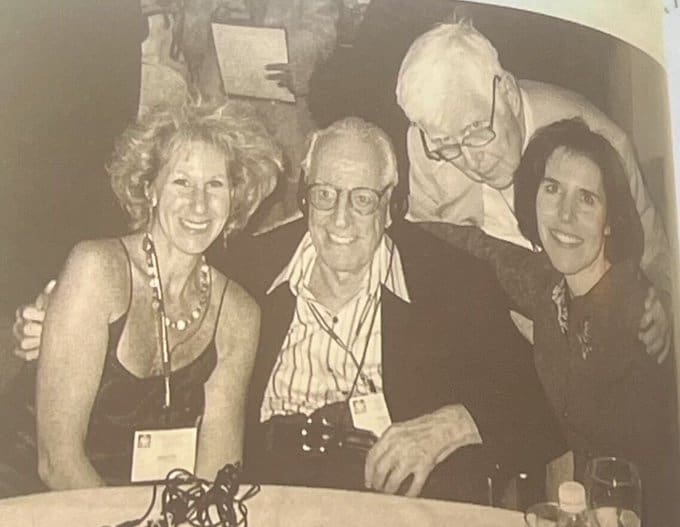
Drs Joffe Ellis, Albert Ellis. Professor Aaron Beck and Dr Judith Beck