
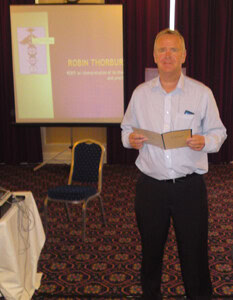
Hypno-REBT in One Session
By Robin W Thorburn
Chapters
- The Consultation and first session
Introduction
I have combined the work of Claire Weekes, an early cognitive theorist/ practitioner and expert on the nervous system, the efficiency, directness and intelligent awareness of the prolific author and psychotherapist Dr Albert Ellis, the man widely accredited with laying down the intellectual foundations of Cognitive Behaviour Therapy and creator of his own brilliant approach Rational Emotive Behaviour Therapy and a Fellow of 12 Divisions of The American psychological Association, author of over 85 books and 800 Academic Papers and the creativity of the Psychiatrist and hypnotherapist Milton H. Erickson.
I am aware that in psychotherapeutic circles there are 2,000 ways the client can metaphorically “break their leg” and probably about 1,000,000 ways to fix it! Choice is a conscious decision made by an individual to effectively become master or mistress of their own destiny. This means that the person defines external factors such as other people and events rather than the events or people defining them! This is pro-active, intelligent and a motivator for a person’s potential, creativity and peace of mind. Choice shapes and encourages an attitude of self-reliance and ways to manage life’s inevitable problems which include events and people; this, in short is the dog wagging the tail and not the tail wagging the dog. Many of my clients are initially allowing the situation or activating event to define them, rather than them defining the situation.
My concern for many people suffering from anxiety, anger, fear and depression is that because of the intense debilitating symptoms they experience, the person then concludes that the resolution must be very complex indeed. Faced with this double bind and the possible analytical, introspective and largely backward therapeutic orientation and subsequent intervention of some therapists, a fear-bewilderment-fear cycle will be created and “maintained” by both parties with an attitude of superstition and child-like thinking “encouraged”.
My findings from my clients who have experienced other forms of therapy are that they grudgingly expect endless hours of talking about self, their past and with tears as they move towards an alleged cathartic release or “integration of self”.
I am reminded of a client of mine who told me that his previous counsellor at the first session pushed a box of tissues towards him, motioned to him to speak and they both sat in complete silence for 50 minutes. Eventually the counsellor, who did not want to intrude upon the client’s frame of reference, broke the silence and said “I now have to act you this direct question, ‘are you suicidal?’” “Not until I came in here” the client replied!
In life we do not walk backwards, we walk forwards!
What I perceive and the feedback I have received from my clients is that my approach encompasses and details the highly important sensitization aspect of the nervous system, which, after all is the prime mover in the symptoms that the client so detests and motivates him/her to the seek therapy. This crucial aspect is usually ignored or placated with a pat on the head and a sugar lump by the inexperienced therapist or further futile discussion of “did you love your mother and hate your father”!
As a therapist I am acutely aware of fearful perception, compensatory demands and inaccurate definitions levelled against self, others or the world and the subsequent nonsensical thinking and the aforementioned feelings created by this chain of neurotic “events”. Indeed I have myself been at the mercy of anxiety and depression many, many years ago, an experience that was frightening and intensely bewildering, akin to a rudderless ship being cast adrift on a storm at sea. Since then, my motivation is to help people with informed educational approaches rather than endless, mindless dredging up of the past. Indeed, it is interesting that the prolific practitioner and researcher into cognitive behaviour therapy Professor Aaron Beck and the aforementioned Dr Albert Ellis were in fact Freudian psychoanalysts but later dismissed the approach as ineffective.
A few years after recovery from my anxiety and depression, I suffered a shattered knee, and then a stroke which affected my balance mechanism; I have had to learn how to walk again psychologically and physically three times!
These experiences, mainly the first, influenced my thinking on neuroses and long-term recovery and subsequently the way psychotherapy is practiced. In fact I can think of no greater “learning process” to passionately concentrate the mind on health, well being and peace of mind.
Rational Emotive Behaviour Therapy/Cognitive Behaviour Therapy explained:
6 April 2005: Study: Cognitive Therapy As Effective As Drug In Treating Depression…In a study of 240 patients, researchers found that Cognitive therapy, a type of treatment that teaches patients to think more realistically, worked as well as a popular antidepressant for moderate to severe depression…If people quit taking Paxil (Paroxitine) after four months, their relapse rate was twice that of therapy patients…it establishes I think once and for all that cognitive therapy does as well as pharmacotherapy, and what’s even more important is that it has a much lower relapse rate,” said Beck. University of Pennsylvania.
In the mid 1950’s, the two therapies of Freudian Psychoanalysis and Behaviourism were fatally wounded by unscientific attitudes, procedural ineffectiveness and a failure to differentiate between a laboratory rat and a human being.
In 1955, Dr Albert Ellis, a New York Clinical Psychologist developed Rational Emotive Behaviour Therapy (REBT) and from this, Cognitive Behaviour Therapy (CBT) evolved through the work of Dr Aaron T. Beck, Professor of Psychiatry at the University of Pennsylvania school of Medicine and Director of The Center for Cognitive Therapy in Philadelphia.
Ellis was recently voted the second most influential Psychotherapist of last century by the American Psychological Association Members, first by the Canadian Psychological Association. REBT is based on the premise that people are not so much disturbed by events, but by our perception of them. “Tell me one thing about the past. I’ll prove it’s not what upset you. It’s how you philosophized about it that made you disturbed” Dr Ellis 19th August 2005.
Many therapies fail to acknowledge that we as human beings are born into the world with a natural feeling of insecurity and a biological tendency to think irrationally. Therefore, we are all a bit like a time bomb waiting to go off. If the wrong buttons are pushed, or continuously pushed, our frustration tolerance is lowered and the activation of excessive insecurity can be triggered.
We then keep ourselves anxious by fearing failure of any kind, then continuously overcompensating for the perceived failure with a demand that we must, should or ought to be loved and approved of; people must treat us well and the world must adhere to what we want. These dysfunctional core beliefs all have a tag on aspect to them which is very damaging i.e. …and if not it’s AWFUL!
With these beliefs, we have moved our thinking into the realms of the irrational as we will then experience inappropriate behaviour and emotions of anxiety, stress, anger, and depression which are self-defeating, destructive and over indulgent. If, on the other hand, we were to keep our thinking flexible, with preferences such as hoping and wishing, we would then be in a position to feel at worst, concerned, annoyed and disappointed then more able to be more tolerant towards ourselves and others and experience peace of mind.
“Most forms of human psychological disturbance are a form of demandingness “. Dr Albert Ellis.
REBT’s other philosophies are;
USA- unconditional self acceptance and
UOA – unconditional other acceptance.
This is a common-sense rational attitude of refusing to damn yourself, if for no other reason than you exist as a mistake-making human being. Remember we are all born into the world with a natural feeling of insecurity and a biological tendency to think irrationally. Trying to say that you are not as bad as saying you are perfect and that is the essence of the problem. Trying to overcompensate for a perceived weakness! When you refrain from damning yourself and others, you metaphorically stop levelling a gun at your and others’ heads. You are then in a position to break the vicious circle of “if my thoughts, deeds and actions are good then I’m good, if my thoughts, deeds and actions are bad then I’m bad. Positive-negative dilemma!
During therapy sessions, self-monitoring and behavioural assignments are prescribed to encourage rational, effective thinking. The client is very much the person who gets self better with the help of the therapist. The world is the laboratory, the client the scientist and the therapist the guide. You can feed a person for the day or teach him how to hunt for the rest their life. You take the cure with you wherever you go. You are back in control. “Given CBT’s, focus on modifying thinking and transferring skills learned in therapy to everyday life (i.e. making the patient his or her own therapist) treatment effects would be expected to persist following termination”. Beck 1995
Clients often request hypnotherapy rather than psychotherapy. Hypnotherapy for far too long has been mis-interpreted as some magical, mystical cure both by clients and therapists alike. After twelve years using it, I have found its effects to be excellent allied with REBT/CBT extremely effective long term. “…at 15 months, CT was superior to both Imipramine and relaxation” (Shear et al (1994)). In short: the conscious mind has to learn what to do so that it can show the unconscious mind. If that were not the case, the very first time you went to drive a car your unconscious could do it for you!
Hypnotherapy is useful for getting the client to visualise themselves in the problematic situation and then applying the rational thinking such as “yes I dislike this situation, it’s a nuisance, a pain but it’s ONLY inconvenient and not awful” thereby experiencing effective behaviour. The client is then prepared for the future with a rational alternative for dealing with the situation and not paralysed with the demands which then lead to awfulness, stress, anxiety, anger, depression and spurious “what ifs” and hesitancy. “Most anxious patients have visual images of danger before and during their anxiety”. Beck, Anxiety Disorders and Phobias
Throughout the sessions, Rational Emotive Behaviour Therapy can be introduced at appropriate times. REBT is very much a case of looking for the evidence to validate the beliefs. My favourite way of disputing negative automatic thinking is asking, “If I took what I am thinking to a court of law, would it be accepted or thrown out by it?” Then more accurate validating can then take place. REBT/CBT is very educational and interesting to learn to use. Flexing the rational muscle can be fun, a bit like physiotherapy for the brain. In short, they are common sense approaches which are low on psycho-babble, plus THEY WORK LONG TERM!
‘The public remains largely unaware of the research supporting the efficacy of CT or other talking cures. But numerous studies show cognitive therapy is as effective as medication at treating depression, and often better than drugs for conditions like anxiety and obsessive-compulsive disorder.’ Washington Post September 3 2002
I now present to you what I call Intelligent Proactive Hypno-Psychotherapy which will help you manage life’s difficulties and self-created emotional disturbances so that you will be able to go into any situation and significantly move anxiety, anger and depression into concern, annoyance and sadness and allow yourself to move towards happiness. I present real case histories a recognised model for understanding nervous illness.
CHAPTER ONE
The consultation and First Session
I usually commence the meeting and greeting stage with asking if my client found my office easily enough. If they came by car, did they get parked, the weather? This of course is somewhat trivial but essential in allowing the person to see that you are pleasant and confident.
Of course, conversation works by association so that we can go onto speak about other things that are happening in the world. Apart from relaxing the person this also gives you the therapist an opportunity to asses how nervous, knowledgeable the client is. This helps you tailor words/approach to their requirements.
No such thing as a resistant client only a resistant therapist. Milton H. Erickson Hypnotherapist
Most clients on the first session will be nervous about going to see a Hypno-psychotherapist, nervous about talking about their problem and anxious that you can help them. It may well be that during this meeting and greeting stage that the client mentions their problem. This is your cue to help.
The client may take time to begin to recall the relevant story regarding their symptoms. These symptoms will invariably range from anxiety, anger and depressed symptoms. The therapist should maintain eye contact and relevant facial expressions for the words spoken and the emotion felt. Showing empathy, judicial humour, knowledge and direction are most helpful.
It is an interesting facet of human behaviour that people try to explain their problems by talking about the situation (A) and then tell me how they feel (C). As the conversation “progresses” they will then invariably tell me how awful they feel (C2) about the situation (A2). What they usually mean is how “horrible the awful feelings are” Horribilising the awfulness Dr Albert Ellis.
Since the situation or activating event (A) is an inanimate object i.e. Public house, supermarket, classroom etc I ask how can this benign situation cause you to feel anxious?!
Their response is usually one of temporary silence then a continuation of irrational/non-self helping thinking/beliefs (B) which then continues to create bad feeling or consequences (C) which then become disturbing memories at the Activating event (C2).
Then the client can tell themselves that they must not feel bad thereby continuing to horribilise the awfulness thus moving anxiety into panic/bewilderment-more fear and creating more disturbing memories (C2).
Every time the door bell rings (A) the dog barks (C) and the client shouts louder at the dog (B), so that the dog barks louder the next time! (C2).
Memory works through our main senses: sight, sound, smell, taste and feeling.
After 40 years in medical practice the one area that is likely to keep a sufferer still stuck even years after the original event is memory. It is always the trickster that lurks in the woodpile. Dr Claire Weekes M.B.E. M.B. D.S.c, F.RA.C.P.
Men are not so much influenced by events but our perception of them. Epictetus (Roman Philosopher)
Since you disturb yourself you can also consciously choose to undisturb yourself. This is not excessive positivity but rational, balanced, elegant thinking. This is the thinking that will create a better outcome for you now, so that memory can then represent the successful emoting/behaviour the next time a person finds themselves in a problematic situation.
Memories live longer than dreams!
REBT is more philosophical than CBT
Dr Albert Ellis New York City April 2007
REBT believes that emotions and behaviour are a consequence of thought and that emotional problems arise from unrealistic thinking. It would therefore follow that by monitoring and identifying activating events, dysfunctional beliefs, consequences and exposing the link to the client by means of the ABC form will give the client a greater insight into the perpetuation of his/her difficulties.
The essence of science is being realistic, logical, open-minded and prepared to try different things.
Examples of Information Processing Errors from Rational Emotive Behaviour Therapy.
Selective Abstraction: Client picks one detail and perceives the whole situation
Arbitrary Inference: Client perceives situation without sufficient evidence.
Overgeneralisation: Client draws conclusion from one situation, or a few, and applies it to all.
Magnification and minimisation: Client makes small negative aspect outweigh larger positive one.
Personalisation: Client identifies with erroneous situations.
Three dysfunctional Core Beliefs:
“I must do well and be approved by significant others, if not I can’t stand it and I am a terrible person when I am not loved and do not do well.” This belief often leads to anxiety, depression, shame, and guilt.
“You must treat me well and if you don’t I can’t stand it and you are terrible person and should be punished.” This belief is associated with feelings of anger, passive aggressiveness, and acts of violence.
“Life conditions under which I live must be the way I want them to be, if not I can’t stand it; poor me.” This belief is associated with feelings of hurt, procrastination and addictive behaviour.
Most forms of human psychological problems are a form of demandingness with inaccurate definitions!
Sadness, annoyance and concern are normal liveable, overcome able emotions. Depression, anger and anxiety are debilitating.
If you were to demand to have £10 in your pocket, then checked your pocket to find that you only had £5 you may well feel anxious, if, however you were to prefer to have £10 in your pocket you will probably feel concerned, sad, or annoyed and then move towards earning £20.
One could say that since there are 7 billion, fallible mistake making human beings on planet earth, bad things are likely to happen. To then say that they should not, ought not, must not happen, moves annoyance, sadness, concern into anger, depression and anxiety (‘awfulness’). We create our own problems by ‘shoulding’ on ourselves and others. Our slogan is “I will not should on myself today!” “Cherchez les shoulds” as Dr Ellis would say.
Demands
A highly intelligent friend of mine was raging one day about the fact he had attended hospital as an outpatient and the nurse taking blood from him had missed the vein in his arm and consequently made it black and blue. This procedure had taken place 2 hours previously, he was now still raging! I confronted his non-self helping demand and said “You NOW are saying that at the nurse should not have done what she has done”! He erupted again by saying she shouldn’t have. “But she has” I said.
“Oh!” he exclaimed, “I am trying to control the uncontrollable!” “What did you want from this situation” I asked? Well, he sheepishly responded that since it was a blood pressure related procedure it might have been better to show her a better way of taking blood!
Inaccurate Definitions
Albert Ellis on his 90th birthday told a reporter that the greatest psychological sickness known to mankind was self-esteem as it is conditional i.e. dependent on what we should say, should look like, should behave, should come across. “Should hood equals shithood so therefore self-esteem is no more than perfume for shithood”.
A woman came into the room and said to Ellis that he looked good, and you look ok he replied. How can you speak to her like that asked the reporter. Look, replied one of the greatest psychologists ever, if she says to me tomorrow that I look bad and I buy into it then I’m bad and it’s back to shithood for me. Sense of self is now dependent on what others say. When we put others on a pedestal we let them define us!
“We are and probably always will be mistake making as human beings but in order to ignore that fact we create fiction, myths, heroes and heroines”.
Ellis tells the story of a woman who came to see him. I’ve fallen out with a friend and now think I’m a bad person. Ellis immediately interrupted: are you telling me that you have never done any good in your life? I‘ve done lots of good things she replied. So that makes you a person who does good and bad things. The only way you could accurately define yourself as good or bad is when you are dead and that you have accurate recollection of every good, bad and indifferent thing you have ever done, then you could draw subtotals and say I’ve done 6,999 good things and 7,000 bad things, so that does make me a bad person, until that day ever comes, it may be more useful to accept the fact that you’re a fallible fucked up human being who does a variety of good, bad and indifferent things!
Ellis, himself Jew, said even Adolf Hitler was not totally bad as he loved his dog and his mistress loved him, yet mother Theresa of Calcutta went to Congress to testify against birth control thereby showing fascistic tendencies! There is good in the worst of us and bad in the best of us, to borrow an old Scottish saying.
Unconditional self acceptance (USA) is central to REBT. Person Centred Therapists give the client unconditional other acceptance (UOA) in the hope the client will do this for self, REBT teaches it! As stated before, REBT is more philosophical than other therapies.
We as humans can think about our thinking and then about our thinking, yet we suffer post traumatic stress disorder (PTSD) Animals it would seem, cannot think about their thinking but do not suffer PTSD. It would therefore follow that we can think wrongly about our thinking and apply logic where none exists.
Since all humans are fallible and mistake making it would make sense to accept yourself, other people and the world, then work to change the things you dislike rather than ‘shoulding’ on self or others. With USA, UOA and UWA (world acceptance) you can into any situation protecting yourself then, define the situation without anxiety, anger or depression.
The person protects self rather than hoping external situations will REBT encourages in vivo de-sensitization, role modelling, shame attacking exercises, rational emotive imagery, disputing, of irrational beliefs and hypnotherapy.
Then by examining the evidence and the justification of the negative automatic thoughts and beliefs this will begin to reduce the intensity by which they are held when these self defeating thoughts are challenged and disputed more realistic ones can be introduced in their place.
It is important to note that REBT holds that positive, pollyannish thinking can be destructive as it can lead to disappointment when goals are not met, so that rational thinking is the key to health. REBT does not believe that past traumatic events contribute towards the client’s current difficulty.