
Principles and Therapeutic Approaches
The cornerstone of cognitive behavioural therapy is the ABC model. This is a form which the therapist may use to enable the client to accurately see how his thoughts affect his behaviour.
A. represents activating event, the location or situation where the problem arises, i.e. in the case of an agoraphobia opening the front door. A behaviourist may deem the opening of the door as the problem.

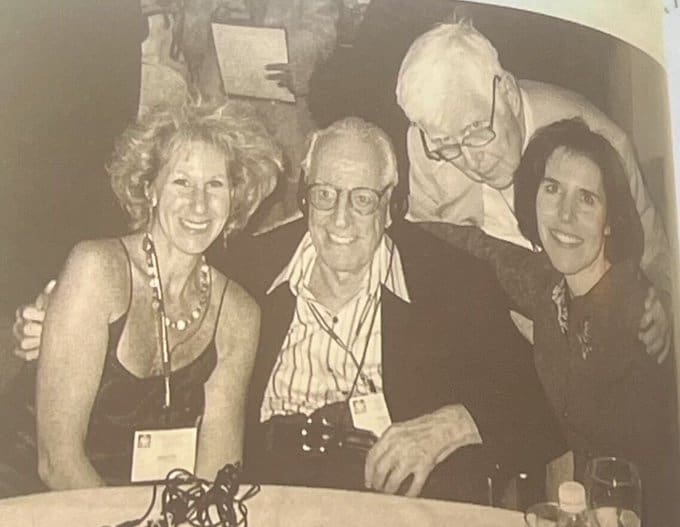
Dr Joffe Elllis, Dr Albert Ellis (originator of cognitive therapy) Professor Aaron Beck and Dr Judith Beck.
B. is for dysfunctional thoughts, images or beliefs, or silent assumptions, labelled so as the client is in the opening phase of therapy and will be unaware of them. They are influenced by the client’s social/cultural background. The fleeting thought from an agoraphobic may be “I will faint if I go out.”
C. is the direct consequences of the cognitive distortion. In the case of the agoraphobic he will stay in and as a result may feel short term relief and despair.
Cognitive behavioural therapy believes that emotions and behaviour are a consequence of thought and that emotional problems arise from unrealistic thinking. It would therefore follow that by monitoring and identifying activating events, dysfunctional beliefs, consequences and exposing the link to the client by means of the ABC form will give him a greater insight into the perpetuation of his difficulties. [7] “An initial goal in therapy is to help a patient restructure his thinking by first becoming more aware of his thought processes.” Then by examining the evidence and the justification of the negative automatic thoughts and beliefs this will begin to reduce the intensity by which they are held when these self defeating thoughts are challenged and disputed more realistic ones can be introduced in their place. It is important to note that C.B.T. holds that positive thinking is equally destructive as it can lead to disappointment when the goals are not met, and that rational thinking is the key to health. C.B.T. does not believe that past past traumatic events contribute towards the client’s current difficulty [8] ” A premise of cognitive therapy is that one develops anxiety not because of unconscious motivations but because one has learned inappropriate ways of handling life’s experiences.” Later we will look at cognitive psychotherapy and its relationship with hypnotherapy in identifying beliefs that may have arisen out of a traumatic event.
The Therapeutic Alliance
Goals
The therapist and client will agree on carefully formulated goals. These goals however can change as therapy progresses. The setting of an agenda at the start of each session will help clarify any pressing problems that the client may have such as disturbing symptoms or sensations from the distorted cognitions [9] “The client will have ruminated for months, perhaps years about his difficulties, and will have many ideas about the problem but still be profoundly confused, ending up in evermore vicious circle of negative thinking.”
Bonds
Therapy is a joint effort, with the therapist being genuine, accepting and providing accurate empathy. These three Rogerian core conditions allow an opening up of the client’s intransigent schemata as the client may perceive himself as being beyond help. [10] ” An effective way to reduce his anxiety is to create a warm therapeutic relationship based on trust and acceptance. Without this, the techniques and procedures of cognitive therapy are unlikely to work.” Rogers believed in the unique control – growth – change potential of the organism. C.B.T. actively guides and directs the client towards his own self-actualisation by teaching the client how to overcome his problems himself. Independence and the ability to solve his own problems are the aims of this short term therapy [11] “The typical course of cognitive therapy for anxiety is from 5 to 20 sessions.” Unlike R.E.B.T. cognitive utilises a socratic approach where the client’s thoughts and beliefs are tested.
Tasks
An essential part of C.B.T. is homework or tasks. Graded activities must be kept to manageable boundaries and be realistically used to encourage the client towards achievement through his own way of thinking. Since, there are 168 hours in a week it is essential for the therapist to know what is happening to the client in the other 167. In between sessions, self monitoring is a highly effective way for the client to record his negative automatic thoughts so that he and the therapist may review them at a later session. [12] “Hypothesis are continually generated and put to the test.” Writing down N.A.T.’s and their consequences on a self monitoring form and equating their efficacy with more functional ones brings the client to greater awareness and in turn will begin to reduce anxiety. Common denominators relating to the client’s problems will become evident to both therapist and client [13] “With anxious patients, the activity schedule can additionally and importantly be used as a means of monitoring anxiety in relation to specific situations.” In the case of the agoraphobic graded exposure, in turn, can also begin to show the client that he can stay out even for a short period of time thus disputing his negative beliefs.